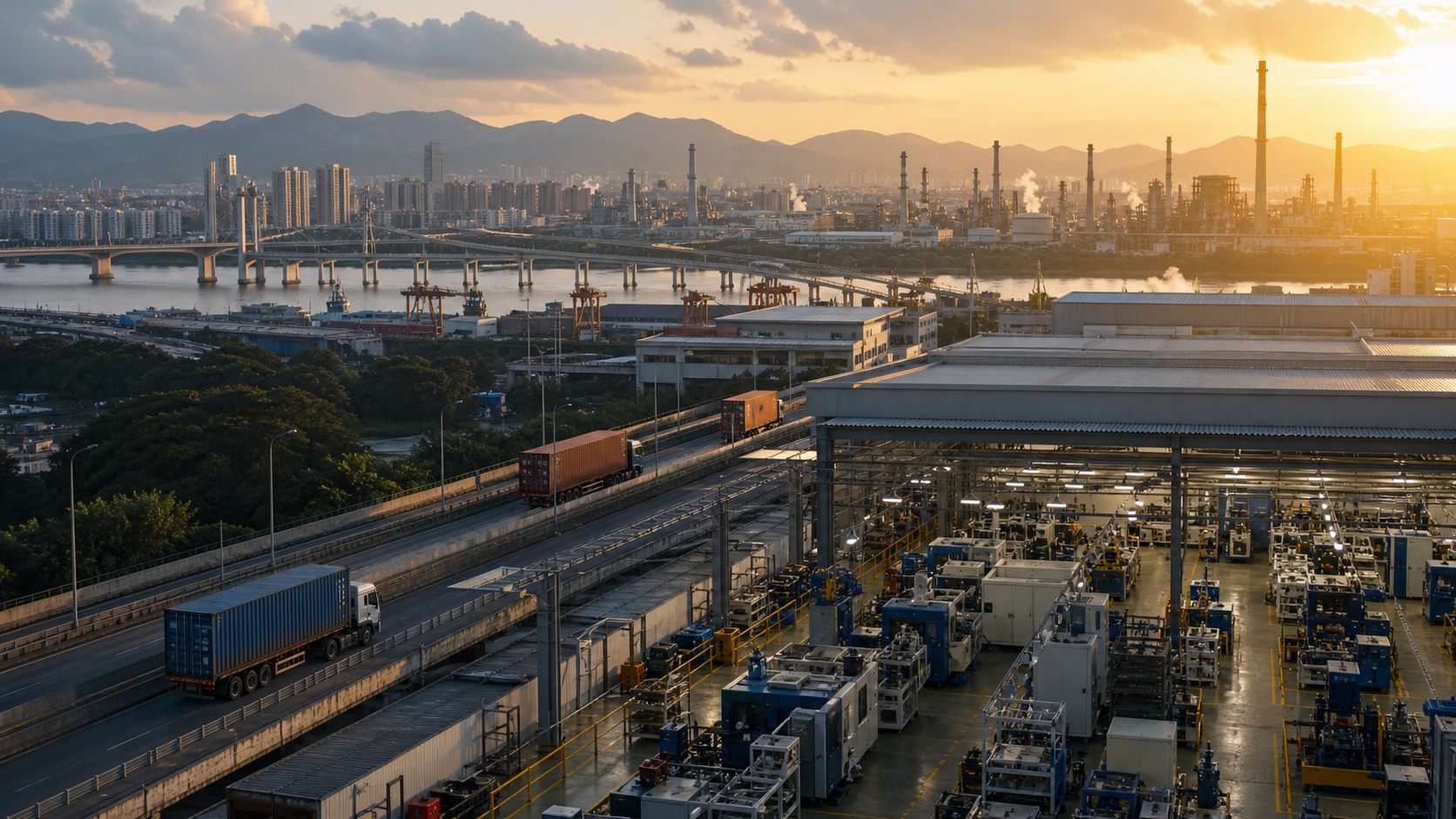
Introduction
“Sourcing from China” often means, more specifically, sourcing from Guangdong. The Pearl River Delta — Shenzhen, Dongguan, Guangzhou, Foshan, Zhongshan, Zhuhai, and neighbouring cities — produces a large share of China’s consumer export goods.
This article explains how the ecosystem is structured, what each city contributes, and why the cluster works as a whole.
The Pearl River Delta At A Glance
Roughly a 100km radius contains:
- Shenzhen — electronics, hardware, prototyping, tech
- Dongguan — OEM manufacturing, plastics, hardware, consumer products
- Guangzhou — trading, wholesale, textiles, chemicals, jewellery
- Foshan — home products, furniture, ceramics, lighting
- Zhongshan — lighting hardware, home electronics
- Zhuhai — electronics assembly, some biotech
- Huizhou — electronics assembly at scale
The specialisation across cities is real but not absolute. Suppliers in each city work with counterparts in the others; a finished product often crosses two or three cities during production.
Why It Works As A Cluster
Three reinforcing factors:
1. Component density. Any given product’s inputs are usually available within the region, reducing lead time and freight complexity. 2. Workforce depth. Migrant and local workers have decades of category-specific skills concentrated here. 3. Logistics infrastructure. Multiple deep-water ports (Yantian, Nansha, Shekou), international airports (Guangzhou Baiyun, Shenzhen Bao’an, Hong Kong), and a highway and rail network that connects the region.
Individual cities elsewhere in China have some of these. Guangdong has all three together.
Category-To-City Guide
- Electronics, IoT, wearables → Shenzhen (design/prototype), Dongguan or Huizhou (assembly)
- Plastic-and-metal consumer products → Dongguan
- Home furniture → Foshan
- Ceramics, sanitary ware → Foshan
- LED lighting → Zhongshan, Foshan
- Textiles, apparel accessories → Guangzhou, Dongguan (Humen)
- Toys → Chenghai (Shantou, technically outside PRD) and Dongguan
- Custom packaging → Guangzhou, Dongguan
Buyers who match the product to the specialising city get better suppliers, faster.
What Guangdong Is Not Best At
- Heavy machinery — northern industrial cities (Shandong, Liaoning)
- Automotive components — northern cities and Shanghai region
- Textiles at commodity scale — Zhejiang and further north
- Small commodities at ultra-low cost — Yiwu, Zhejiang
The Yangtze River Delta (Shanghai, Zhejiang, Jiangsu) is the other major cluster, with different specialisations. Some product categories belong there rather than in Guangdong.
Working Across The Cluster
For most sourcing projects, “Guangdong-based” is a good filter but not sufficient by itself. The relevant question is which specific city and which specific industrial township within it.
A sourcing partner with cluster-wide knowledge (rather than one-city focus) can route the product to the right city without the buyer needing to learn every industrial township.
FAQ
Can everything be sourced from Guangdong? Most consumer goods, yes. Some categories fit better elsewhere in China — and a good sourcing partner will say so rather than force-fit locally.
Do I need a Guangdong office to source here? No. Remote sourcing with a local partner works well and is how most overseas buyers operate.
How does Guangdong compare to the Yangtze River Delta for cost? Comparable for most consumer goods; category and specialisation matter more than region.
Source From The Right Corner Of Guangdong
Hansen operates across the Pearl River Delta and matches projects to the right city and township. If your product could come from here, see Guangdong Sourcing or start a project.